Let’s run Julia everywhere from mobile to web
Satoshi Terasaki@AtelierArith
Link to slide ↓↓↓

Goma-chan (my family)

Goma-chan (projected into 2D space)
What I created
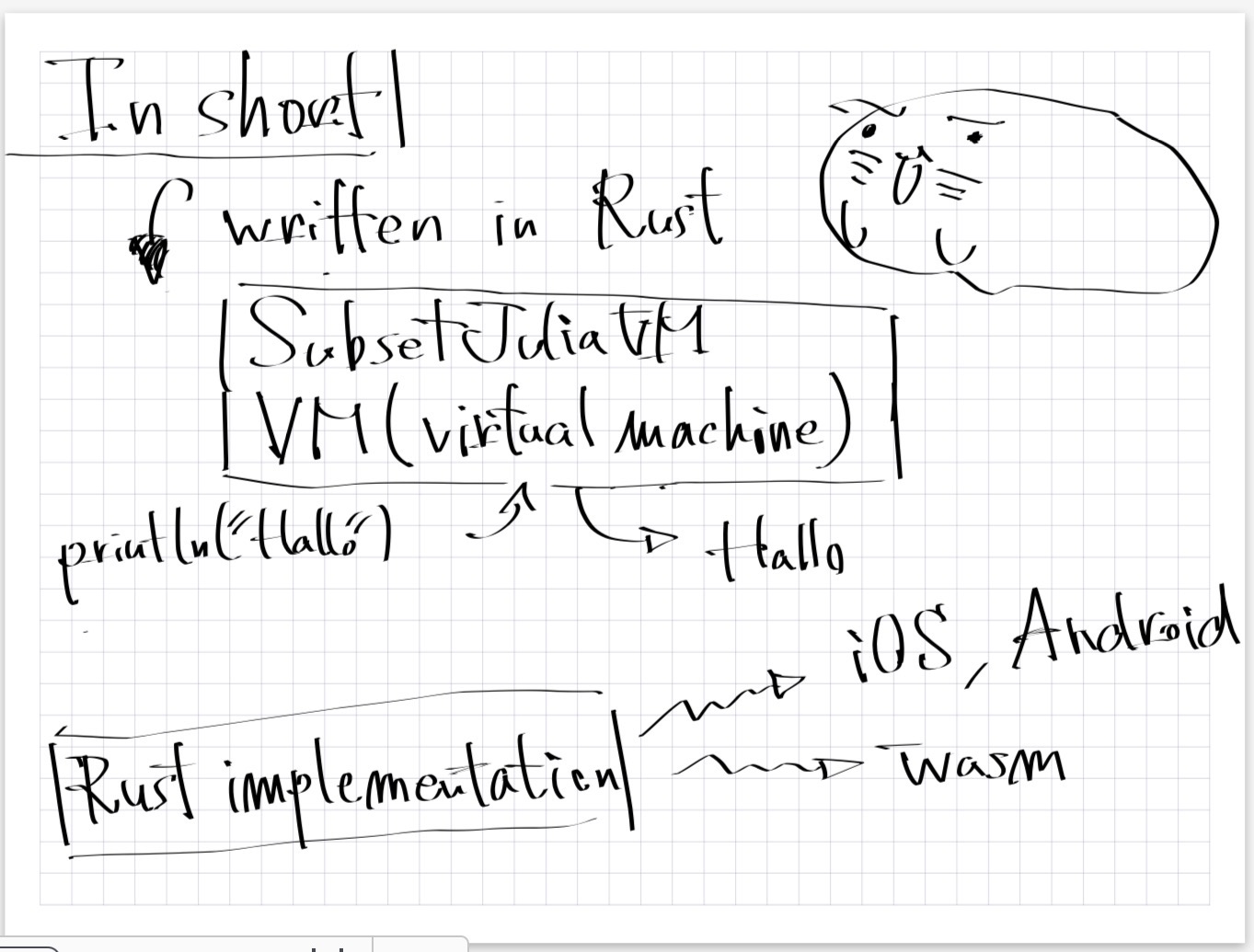
- SubsetJuliaVM — a stack-based VM for a subset of Julia
- Looks like Julia and walks like Python
- CLI binary name:
sjulia(think “subset Julia”) - Implemented in Rust
- Runs on iOS and Android devices
- The VM compiles to WebAssembly, so it also runs in the browser
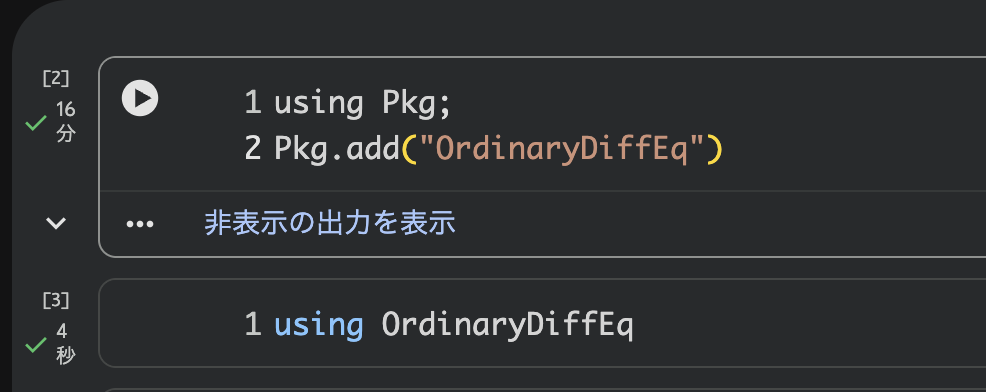
- Supports parts of Plots.jl, OrdinaryDiffEq.jl, Symbolics.jl, AbstractAlgebra.jl, and more
What I created
Deliverables
iOS / iPadOS — a native app with no JIT, fully App Store compliant



Google it SubsetJuliaVM
Live demo (inside these slides)
- Seeing is believing
- The next slides embed the very same WASM VM.
Edit the code and run it with Ctrl+Enter / ⌘+Enter (or Run). Press Clear to clear the output.
Hello World
Fractals (Interact + Distributions + Plots)
Why I created it
- I loved Pythonista (iOS app)
- I wanted to run Julia on my iPad — offline
- I was asked by some of the teachers who teach mathematics in Japan, “Can I use Julia on an iPad?”
What about Binder or Google Colab?
- Unusable where the internet connection is unreliable
- Installing external packages takes a long time
Can we run official Julia on iOS? (1/3)
- It’s difficult to run the original functionality as-is.
- Official Julia relies on JIT compilation
- Ordinary iOS apps cannot freely generate and execute native code at runtime (W^X)
- App Store rules also restrict downloaded code that changes app functionality (Review Guidelines §2.5.2)
- SubsetJuliaVM uses a bundled interpreter instead: bytecode stays data as
Vec<Instruction>.
Can we run official Julia on iOS? (2/3)
Experimentally, yes — but this is not an official iOS port.
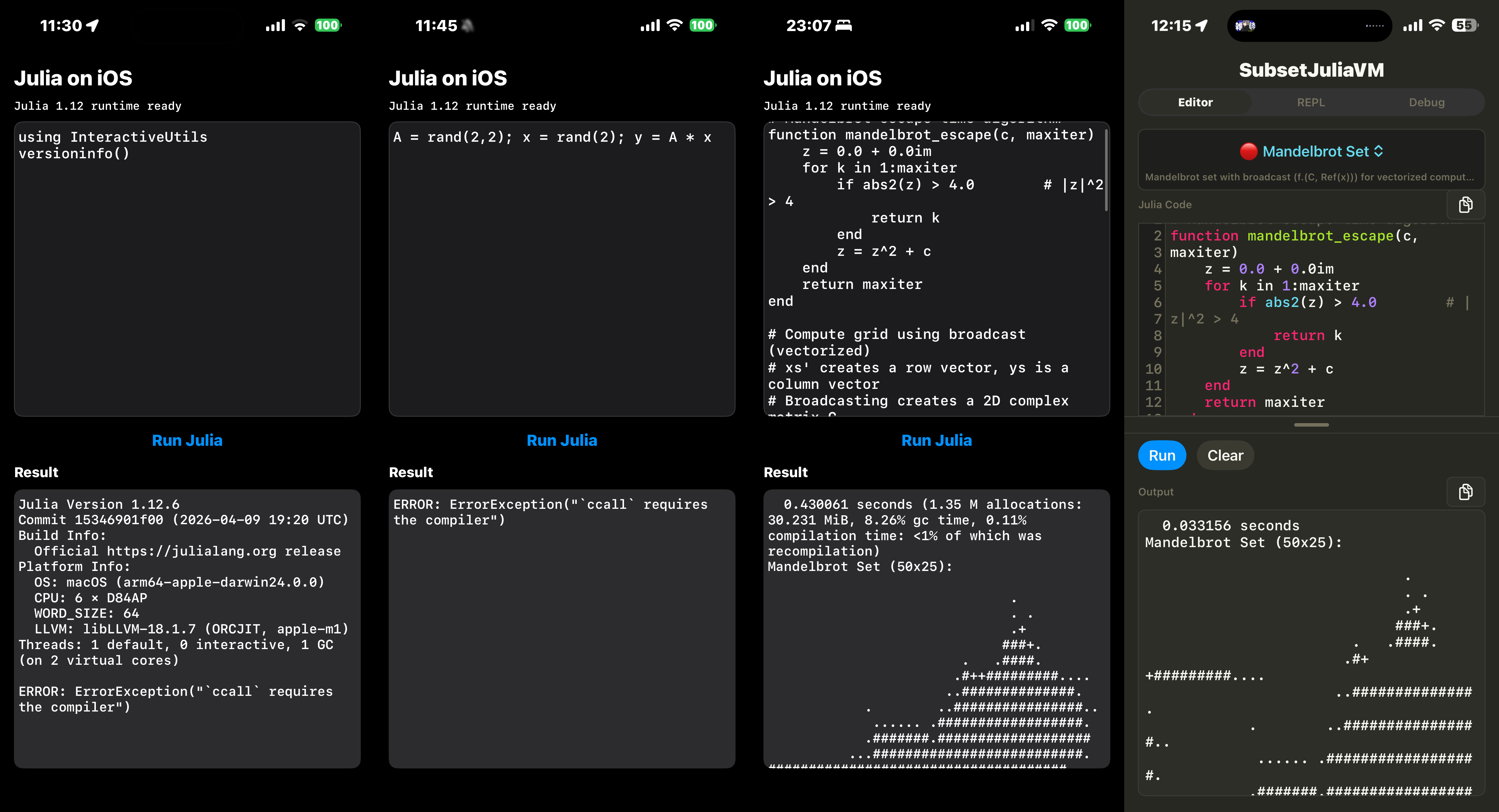
Verified with Julia 1.12.6 on a physical iPhone 15 Pro Max:
- Bundle the official macOS arm64 runtime and sysimage
- Rewrite Mach-O platform metadata and sign every dylib
- Run with
--compile=noand small compatibility shims
Major limitations
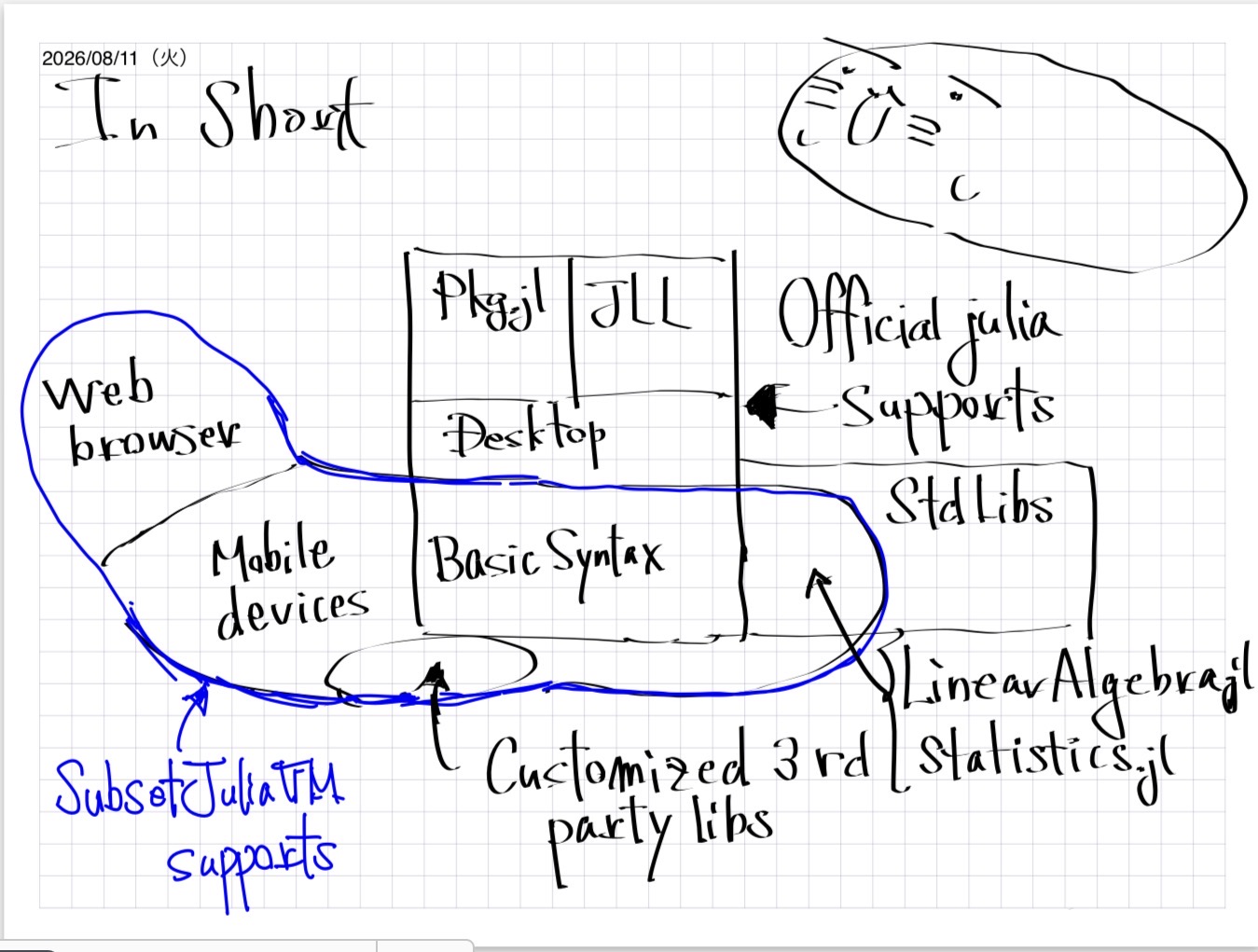
- Most standard libraries, packages, and JLLs are unsupported
- BLAS-backed matrix operations still fail with
`ccall` requires the compiler - Development-signed research prototype; not App Store-ready
Can we run official Julia on iOS? (3/3)
How I created SubsetJuliaVM
- Apps like Pythonista and Carnets do run on iOS.
- So why not build a virtual machine that accepts Julia syntax?!
- I don’t have the ability to create this 😭
- Let’s use AI 🤖
- Built with heavy use of AI tools: Claude Code, Codex, Cursor, DeepSeek, Kimi, etc.
Let’s actually build SubsetJuliaVM!
Julia source
→
parse → CST
→
lower → Core IR
→
compile → bytecode
→
stack VM → result
Result: AtelierArith/julia-vm-oss
$ git clone https://github.com/AtelierArith/julia-vm-oss.git
$ cd julia-vm-oss
$ ./scripts/sjulia_install.sh   # Windows: pwsh -File scripts/sjulia_install.ps1
$ sjulia examples/mandelbrot.jl
  0.027875 seconds
Mandelbrot Set (50x25):

                              .
                              . .
                              .+
                             ###+.
                        .   .####.
                       .#++#########....
                      ..##############.
            .        ..################..
             ...... .##################.
            .#######.###################
          ...##########################.
#####################################..
          ...##########################.
            .#######.###################
             ...... .##################.
            .        ..################..
                      ..##############.
                       .#++#########....
                        .   .####.
                             ###+.
                              .+
                              . .
                              .
How SubsetJuliaVM differs from official Julia
How code is interpreted and executed:
Each cell: who does it → what it produces
| Stage | Official Julia | SubsetJuliaVM |
|---|---|---|
| Parsing | flisp / JuliaSyntax.jl → AST | pure-Rust parser → CST |
| Lowering | Julia’s lowering → lowered IR | Rust lowering → Core IR |
| Code generation | LLVM JIT at runtime → native code | bytecode compiler before execution → bytecode |
| Execution | CPU runs native code | stack VM interprets bytecode |
| Runtime library | C runtime + pure-Julia base/ |
Rust builtins + a pure-Julia subset |
- With no JIT, SubsetJuliaVM runs even on iOS (W^X) and WASM
What SubsetJuliaVM does not provide
Everything that would break the sandboxed, offline, no-downloaded-code model:
- Pkg.jl / package management — no
Pkg.add, no registry, no downloads;using Xonly reaches the ~34 packages bundled into the binary - Network I/O — no Sockets, no Downloads/HTTP
- Filesystem access — file operations are unimplemented;
includeresolves through virtual embedded paths - External processes — no
run(cmd) - C interface — no
@ccall/pointer/unsafe_*
What we support
- Basic Julia syntax (subset)
- ~34 bundled 3rd-party packages (no download), including:
- Plots, StatsPlots, JSXGraph, Interact
- OrdinaryDiffEq, SciMLBase
- Symbolics, AbstractAlgebra, Primes, Combinatorics
- Distributions, StatsBase, Optim, QuadGK, HCubature
- StaticArrays, SparseArrays, SpecialFunctions, Quaternions, Rotations, …
- These have been re-implemented specifically for SubsetJuliaVM.
What we support
juliars
An experimental Julia → Rust AoT transpiler (same frontend as the VM).
- Pipeline: source → CST → Core IR → Rust source →
rustc -O→ native binary - Unlike JuliaC / PackageCompiler, it does not need
libjulia - Best for scalar numerics, loops, arrays — the broad package surface stays on the VM
- On the coprime-π / Mandelbrot benches: about as fast as official Julia
Performance: Julia vs. SubsetJuliaVM
Coprime-π benchmark — \(P(\gcd(a,b)=1)=6/\pi^2\) (Apple Silicon macOS):
| Runtime | Time |
|---|---|
| Official Julia | 2.12 s |
juliars (AoT) |
1.89 s |
sjulia (VM) |
9.99 s |
| Python 3.14 | 16.76 s |
- AoT is about as fast as official Julia
Interested in the Android app?
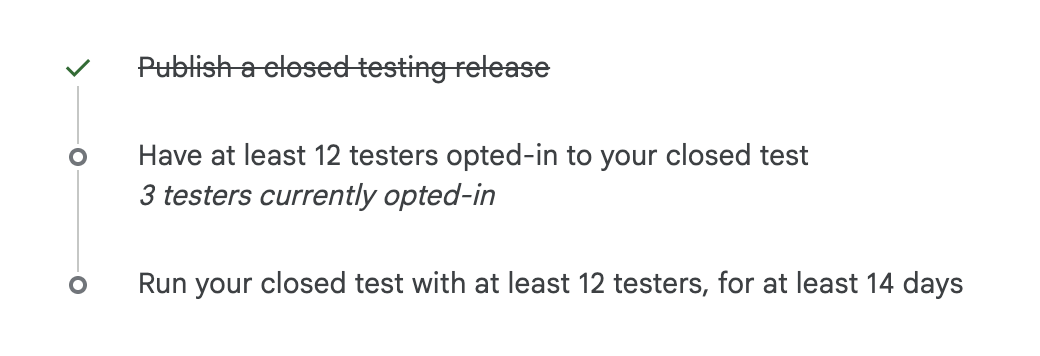
- Coming soon — we are looking for testers.
- Please contact
s.terasaki@atelier-arith.jp
Conclusion

Thank you!!!
Q&A material: see the Appendix slides